
I first heard about the concept of “Guerrilla Gardening” several years ago, back when I lived in Adelaide, from the thoughtful and creative person behind the “Local & Bespoke” blog. Her Instagram and blog posts share many snippets of the practical and often beautiful ways she repurposes, repairs or gives new life to many everyday items, alongside her efforts to protect and celebrate the natural environment.
I often find myself inspired or motivated to try something after seeing one of the Local & Bespoke posts. I certainly feel comforted to know that other people like her are out there, each of us doing what we can in our own way, and finding and sharing joy, knowledge, and solidarity along the way. We might all be in different cities, different states or even different countries, locally doing something that might feel like it’s insignificant, but blogs like these remind me that we are all connected and fighting common global issues facing us all. It makes it feel like little actions matter and it is not futile. It also makes me reflect on that while you may never know it, your actions may be noticed by others, and from them observing or learning from you they might go on to feel encouraged to take action themselves, whether that is picking up some rubbish, writing a letter to a politician, taking part in non-violent protest actions, or mending an old garment rather than putting it in the bin.
Anyway, one of the many things I learnt about for the first time from Local & Bespoke’s blog, was the concept of Guerrilla Gardening. And many years later, in another state, that little seed she planted in my mind has led me to propagate my own local native plants and start establishing little pockets of native garden in neglected spaces in my new neighbourhood. In case you happen to read this – thank you M. 🙂
+++++
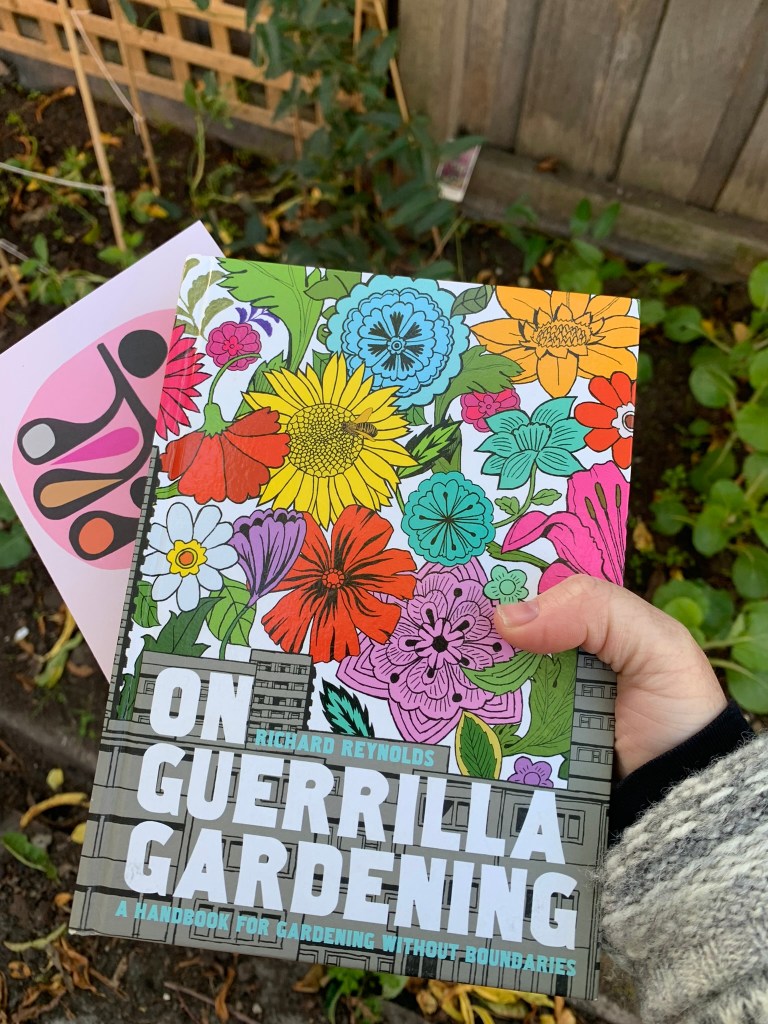
Guerrilla gardening can be defined as “The illicit cultivation of someone else’s land”…it’s foundations lie in the recognition that “Most people own no land. Most of us live in cities and have no garden of our own. We demand more from this planet than it has the space and resources to offer. Guerrilla gardening is a battle for resources, a battle against scarcity of land, environmental abuse and wasted opportunities. It is also a fight for freedom of expression and for community cohesion. It is a battle in which bullets are replaced with flowers (most of the time).”
On Guerrilla Gardening – A Handbook for Gardening without Boundaries, by Richard Reynolds.
+++++
While Guerrilla Gardening tends to sound a little bit militant, and I don’t necessarily agree with all interpretations of it, the way I like to think of it is more like creating and establishing little pockets of native garden in otherwise neglected or unloved public spaces. For me the intention is for these little pockets to help provide some shelter, habitat and food for birds, animals, reptiles, and insects (especially pollinators), while also bringing some joy to humans who pass by. I don’t particularly find myself drawn to the illicit side of guerrilla gardening. And also when contemplating whose land we are gardening on, I think it is important to acknowledge that much of modern Australia can be considered to be established on stolen land, given the nature of colonisation and lack of treaties with the First Nations people who were here and caring for the land for many thousands of years beforehand. Land ownership issues aside, I approach Guerrilla gardening by asking myself what reasonable person wouldn’t prefer to see some little native plants growing as a border to a carpark for example, rather than a neglected concrete bed full of dusty dirt, weeds and rubbish? It is surely improving the land rather than causing any harm when done thoughtfully on neglected earth.
+++++
While Guerrilla Gardening as described in Richard Reynolds’ handbook mostly did not seem to care what kind of plants or seeds are spread around, I personally feel like spreading introduced species, especially invasive or noxious weeds, even if they have pretty flowers, is not ideal in Australia. So my ‘Guerrilla gardening’ philosophy is to use seeds and plants that are native to Australia, and if I can find species that are indigenous to the local area, even better. I am in the early stages of putting my plans into action, but so far all the plants I have used in my Guerrilla gardening sites I have grown from cuttings from native plants in my area. I am also currently growing some more native plants from seed. I will have to expect that not all the plants will survive, so it is best for me to grow them from cuttings and seeds rather than buying established plants from a nursery for these kinds of activities, and to focus mainly on plants that I think will be hardy enough to survive (once established) without much maintenance.
++++++
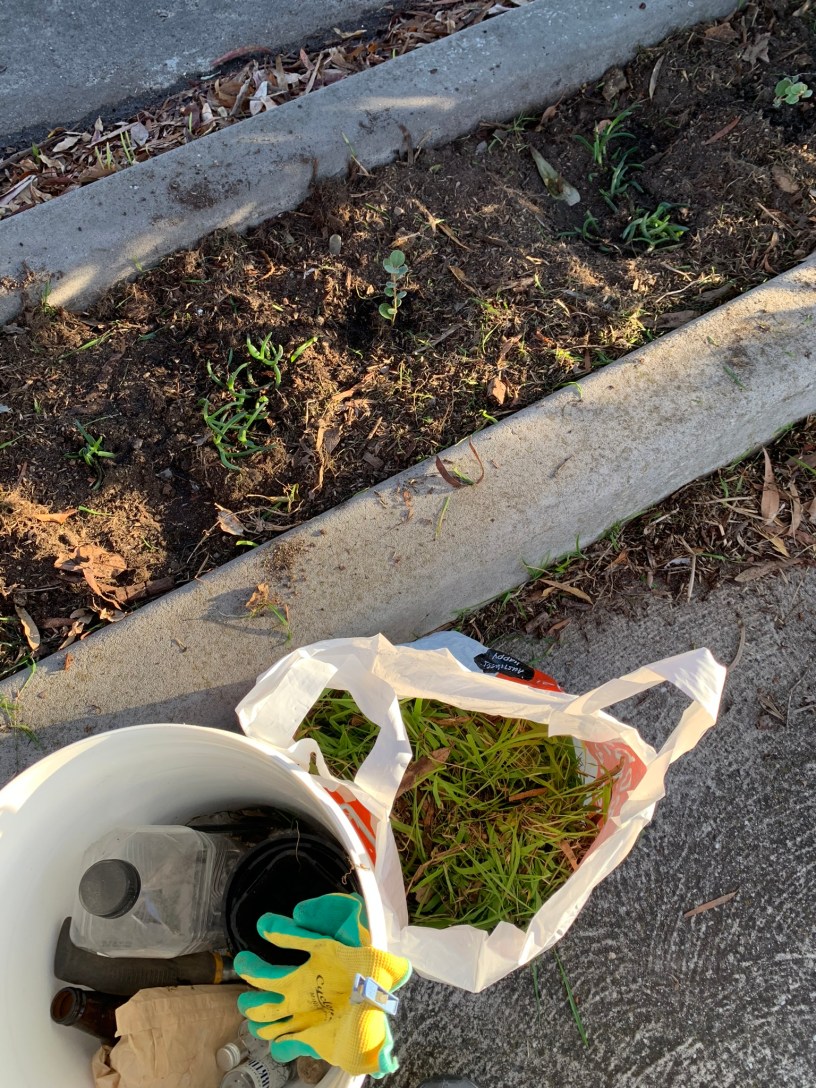
The first site in West Footscray (known affectionately by locals as WeFo) that I have identified for my Guerrilla gardening contains some very neglected shallow concrete beds, mostly full of dirt, weeds and rubbish. There are quite a lot of these neglected bare patches, in between a few established trees and plants. So far I’ve started planting in one small patch of one of these concrete beds, and will see how it fares before slowing filling in other bare patches with more native plants. As these beds surround a carpark, it is likely people will step over them as a thoroughfare to the nearby shops or to get to their cars, so for that reason I am specifically choosing mostly low-lying ground cover plants, and a small number of low shrubs, so they shouldn’t impede anyone stepping over the bed as they grow, and thus I hope are less likely to be regarded as a nuisance to be pulled up.
Here are some ‘before’ and ‘after’ pictures taken on the day of planting.

After planting: Rubbish picked up, grass/weeds removed, and karkalla, ruby salt bush (indigenous to Maribyrnong area), and Correa alba cuttings/seedlings planted.


++++
It’s a small start, but already looks better to me…Let’s see how this first patch goes… 🙂 With a little bit of effort and a lot of love I hope to start creating more little pockets of native garden around my local neighbourhood in suitable places that look neglected. I already regularly pick up rubbish from these places, and imagine (perhaps naively) that if instead of dirt and weeds, they were full of established native plants, then they would be less inviting spots to drop rubbish.
 Happy Hobbit Life: Too many tabs open